

If you’re anything like most business leaders and marketers I work with, you’re juggling a dozen marketing priorities at once, content calendars, paid media, SEO, sales alignment, customer experience, and endless dashboards. But here’s the hard truth:
Marketing activity is not the same as marketing effectiveness.
Without a thorough audit, you’re making decisions based on feelings instead of evidence. And in 2026, with increasing competition and rising budgets, that’s a luxury you can’t afford.
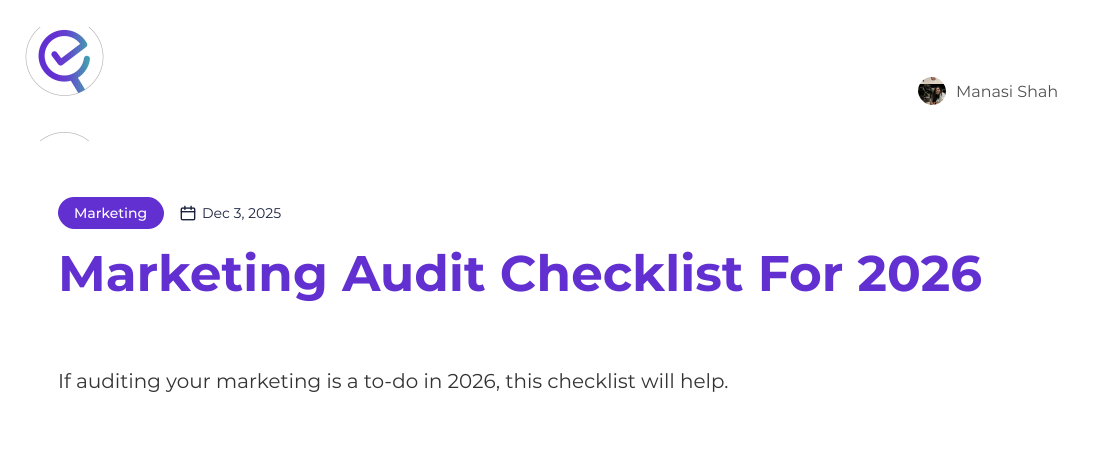
Let’s walk through a detailed, actionable marketing audit checklist 2026 that helps you not just measure what’s happening, but drive improvements that matter. I’ll guide you using simple language, expert nuance, and real data.
Why You Must Audit Your Marketing in 2026
Before we jump into the checklist, let’s ground ourselves in why this matters now more than ever.
According to industry forecasts:
- The digital marketing landscape is projected to grow at a 17.6% CAGR through 2026, with total ad spend exceeding $526 billion in 2024 and increasing further by 2026. Yet only 61% of marketers believe their strategy is effective. (Loopex Digital)
- A solid content strategy is no longer optional. Content marketing revenue alone is forecast to surpass $107 billion by 2026. (Sixth City Marketing)
- AI isn’t future tech anymore: over 80% of marketers are actively using generative AI, and many report measurable ROI improvements. (TechRadar)
Which means: If you’re still doing traditional audits once a year or basing decisions on gut alone, you’re already behind.
What Is a Marketing Audit, Really?
In plain English: a marketing audit is like a full‑body health checkup for your marketing engine.
It’s a systematic evaluation of everything you do; from strategy and brand messaging to channel performance and customer experience, to answer one critical question:
What’s actually working, and what’s costing you money and opportunities? (Camphouse)
Audits give you a data‑driven foundation for decisions, stopping inefficient spending, improving revenue outcomes, and strengthening internal alignment.
Must Read: Understand How Marketing Audit Works
2026 Marketing Audit Checklist (Actionable & Strategic)
1. Define Your Audit Goals
Start by answering:
- What are we auditing?
- Full marketing function?
- A specific campaign?
- Paid media only?
- End‑to‑end customer journey?
- What outcomes are you measuring?
- Leads?
- Revenue?
- CAC (Customer Acquisition Cost)?
- Customer experience?
Example Objective: “Reduce CAC by 20% while increasing high‑quality leads by 30% compared to last year.”
2. Strategy & Goal Alignment
Ask yourself:
- Do you have clear, documented goals for each channel?
- Are they tied to revenue or just output?
Action Step:
- Map each marketing KPI to a revenue driver (e.g., CAC, LTV, conversion rate).
Pro Tip: If you can’t say how many additional dollars a tactic will bring; it’s not strategic, it’s tactical.
3. Brand & Messaging Audit
Your customers should feel your message consistently everywhere.
Questions to ask:
- Does your messaging reflect your audience’s current priorities?
- Is it aligned across websites, social media, email, and ads?
Visual content is 43% more persuasive than text alone, but many brands still fail to evaluate whether visuals match brand positioning. (Sixth City Marketing)
4. Website & Experience
Your website isn’t just pretty, it’s your conversion engine.
Check:
- Page load speed (aim for \<3 sec)
- Mobile responsiveness
- Conversion paths (Is it too many clicks to action?)
Example: If your homepage bounce rate is high but traffic is growing, you have a conversion problem, not a traffic problem.
Must Read: How to Increase Website Session Duration?
5. Content Performance & Relevance
Content isn’t just posts on LinkedIn or blogs in an archive, it’s a lead generating asset when strategic.
- Are your top content pieces driving leads?
- Which topics perform best?
- Do you repurpose content across channels?
Content that educates, builds trust, or answers intent‑based queries performs better than generic volume posting.
54% of marketers now measure content ROI. Visual and video content are dominating user engagement. (Sixth City Marketing)
Must Read: How to Do a Content Audit?
6. SEO & Organic Search Audit
If you’re not ranking where your audience searches, you’re invisible.
Checklist:
- Keyword rankings for priority terms
- Technical SEO (crawl errors, sitemap issues)
- Backlink profile health
Must Read: How to Run a SEO Performance Audit?
7. Paid Media Efficiency
Paid channels need ROI scrutiny:
- Is your ROAS (Return on Ad Spend) positive?
- Are audiences segmented?
- Are campaigns scaled or just running?
Tip: Always evaluate landing page alignment, even the best ads fail if the landing experience is bad.
Must Read: How to Do a Paid Ads Audit?
8. Email & CRM Health
Email marketing still rules ROI:
- Some reports show email may generate up to $36 for every $1 spent. (Reboot Online)
Check:
- Open and click‑through rates
- Segmentation & personalization
- Lead scoring accuracy in your CRM
9. Social & Community Engagement
It’s tempting to post often, but without meaningful engagement:
- Are you tracking engagement rate, not just follower counts?
- Is social contributing to revenue goals?
More than half of marketers now view social as a customer experience channel, not just awareness.
10. Sales & Marketing Alignment
If your sales team doesn’t trust marketing leads, performance suffers.
Questions to audit:
- Who qualifies MQLs?
- What’s the lead handoff process?
- Are there closed‑loop feedback loops?
True alignment reduces friction and increases conversion likelihood.
11. Customer Experience (CX) Impact
Marketing doesn’t stop at conversion.
- How does your onboarding feel?
- Do customers churn because of misaligned expectations?
Example: Customer satisfaction scores (like ACSI) correlate strongly with loyalty and revenue growth.
12. Competitive Landscape & Benchmarking
Your audit isn’t complete without context.
- Where are competitors winning audience attention?
- What channels are they focusing on?
Competitive insights help you spot opportunity gaps faster.
13. Dashboard & KPI Review
A dashboard without insight is noise.
- Are your dashboards actionable or vanity?
- Do they connect activity to revenue outcomes?
Must Read: Marketing KPIs That Should Never be Taken Off Your List
14. Innovation Audit
Ask:
- Are you experimenting with emerging tech like AI?
- Are you tracking innovation outcomes, not just trying “cool stuff”?
In 2026, AI‑enhanced campaigns are expected to significantly boost ROI when implemented strategically. (PopupSmart)
Next: Turn Marketing Audit Insights Into Action
Collecting audit data is only half the job.
Here’s how you operationalize it:
1. Prioritize with Precision
Not all gaps are equal. Use these criteria:
- Impact (How much revenue lift?)
- Effort (How complex is execution?)
- Risk (What happens if you don’t act?)
Rank initiatives accordingly.
2. Build a Roadmap
Turn your audit into a 90‑day action plan:
| Priority | Initiative | Owner | Metric | Deadline |
|---|---|---|---|---|
| High | Improve SEO for Top 20 Keywords | SEO Lead | +30% Organic Traffic | Q2 |
| Medium | Email list re‑segmentation | CRM Team | +15% Open Rates | Q1 |
| Low | New social channel tests | Social Lead | +10% Engagement | Q3 |
Final Thoughts on 2026 Marketing Audit Checklist
Your marketing audit isn’t a chore, it’s a strategic advantage. Done right, it shifts you from guessing to predictive decision‑making.
Here’s a simple truth:
You don’t just audit to fix; you audit to grow smarter, faster, and with clarity.
You’ll walk away knowing exactly where to invest, what to stop, and how to build more impact with fewer resources.